Self-experiment: Learning Chinese (Mandarin), Day 1
Learning Korean changed the way I experience language, culture and even identity. Now, for the first time in years, I’m starting again from zero with Mandarin Chinese.
I never really documented my Korean learning progress. Therefore, it’s hard to trace back when I used which learning strategies. But I can remember the methods that helped me the most. And those are the ones I want to transfer to learn a new language. I’m convinced that it needs a healthy mixture of cultural inputs and discipline. That’s why as a first step I’ve created a clear learning structure. Each day I’m learning and repeating new vocabulary. I’m using Anki’s algorithm, which was created by Gabriel Wyner, the author of “Fluent Forever” – a book I’d recommend to everyone who’s interested in languages.
In addition, I’m consuming Mandarin through music and movies daily to get used to its sound and to be able to pick up on words and sentences. Those are the main points that helped me with learning Korean in the beginning.
But this time I’d like to take one step further and train my pronunciation from day one on. Mandarin is a tonal language and that’s why it’s important to remember the right pronunciation from the beginning. I’m using a pronunciation chart which I practice daily to remember each sound.
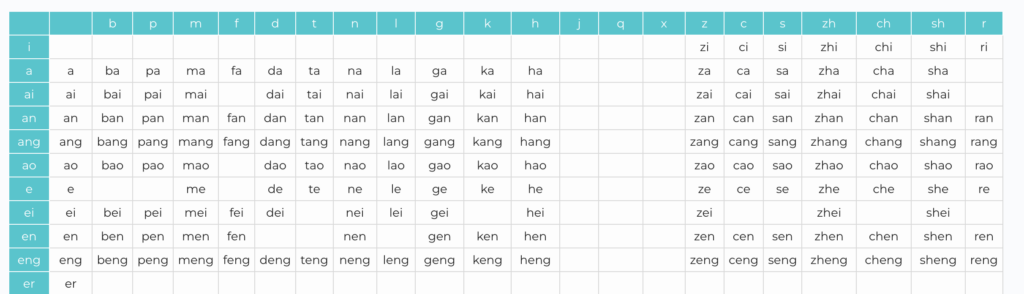
There’s a mistake I had made while learning Korean, which is using the wrong keyboard. That’s why I want to get used to the system that is most commonly used in China. Which means I’m not focusing on being able to write words by hand but to recognise and correctly use them on the computer. Hence, I’m not copy-pasting words but typing each sign in by myself.
I’m creating a vocabulary list out of basic vocabulary that can be found online and from songs that I’m listening to daily. By using songs I use a creative way to simultaneously remember the sounds.
In conclusion, my focus this week will be: Pronunciation and repetition.
But why Mandarin?
If there’s a language that is at least as hard for us German speakers to learn as Korean it must be Chinese. But at the same time it’s also a language that can come in handy in a lot of areas. Plus, I’ve always had a fascination for the language and have been consuming Chinese entertainment. I also would like to travel to China someday. And if I’m lucky my Korean skills might help me during my learning process. Korean and Mandarin are two very different languages but as far as I know they also have some similarities. Once I get into the language I will see how much my Korean will help me in reality.
For now, I’m simply excited to slowly make the language feel familiar; one sound, one sentence and one song at a time.